


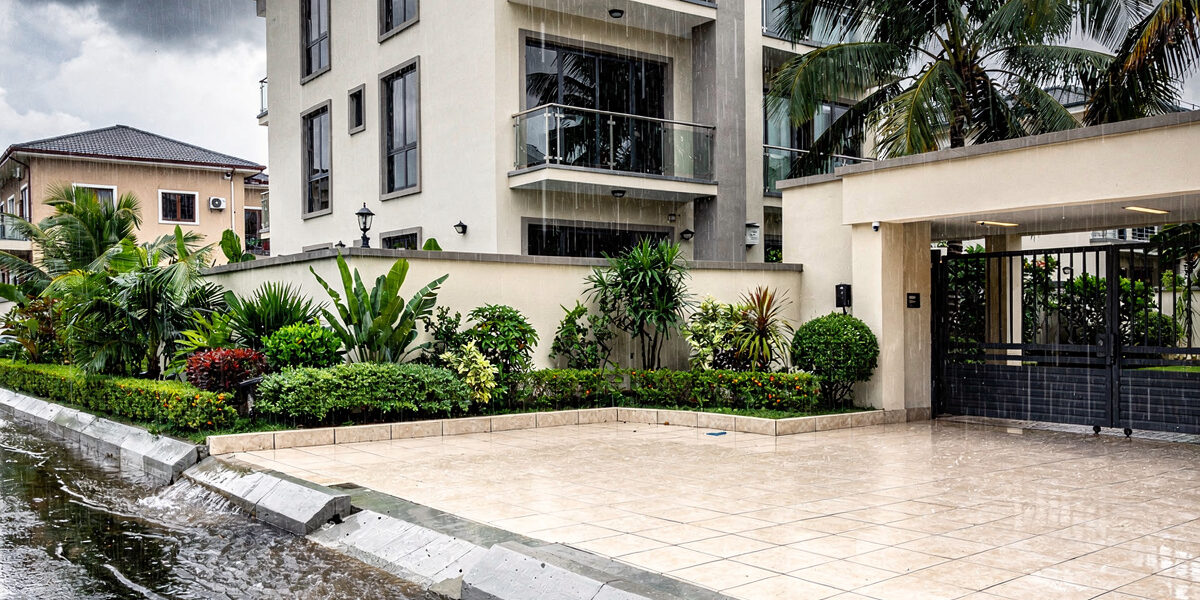
How to Avoid Buying a House in a Flood-Prone Area in Lagos
A house can look perfect in January and sit surrounded by water in July. The paint is fresh, the finish looks clean, the price feels fair, and the seller is in a hurry. Then the first heavy rain comes, and the compound becomes a pond.
This is not a rare event in Lagos. The World Bank has put the total cost of flooding in Lagos at around 4 billion dollars every year. For a buyer, that number is not abstract. It is the difference between an asset that grows and one that rots from the foundation up.
Learning to spot flood-prone areas in Lagos before you pay is one of the most valuable skills a property buyer can have. This guide explains why the city floods, which areas carry the most risk, and the specific checks that tell you whether a property is safe.
Why Lagos Floods More Than Almost Anywhere
Lagos has a geography problem that no amount of paint can fix. It is a low-lying coastal city squeezed between the Atlantic Ocean and a large lagoon, and water has a habit of returning to where it has always been.
A 2025 review of the city’s flooding published in the journal Frontiers in Climate found that rivers, lagoons, creeks and the ocean cover roughly 22% of the state’s landmass. The same study records sea levels rising by about 3.7 millimetres a year, which slowly pushes the water table higher across the whole coastline.
There is also the problem of backflow. During heavy rain at high tide, the lagoon is already full, so stormwater has nowhere to drain. Lagos State has warned residents of Ikoyi, Lekki, Victoria Island and the coastal parts of Epe and Badagry to expect this exact effect.
Then there is what people have done to the drains. As one account of the state’s war on the waterways put it, canals became building sites, setbacks became shopfronts, and drainage channels were quietly strangled by concrete and refuse. Water that cannot pass simply rises.
The Flood-Prone Areas in Lagos You Should Know About
No neighbourhood is a guaranteed safe bet, and no neighbourhood is uniformly doomed. Flood risk in Lagos is street by street, sometimes house by house. But some areas carry more inherent risk because of where they sit.
The Frontiers in Climate study grouped the worst-exposed zones into coastal areas, naming Lagos Island, Lekki, Victoria Island, Ajeromi-Ifelodun, Amuwo-Odofin and Apapa because of how close they sit to major water bodies. It placed mainland areas such as Surulere, Yaba, Ojo and Festac in a second group, where the problem is less about the sea and more about poor drainage and ignored setbacks.
In 2026, as flooding worsened, Lagos State told residents in low-lying parts of Lekki, Ikorodu and Ajegunle to move to higher ground. When a government tells people to relocate from an area, a buyer should treat that as free and serious market intelligence.
The point is not to avoid these flood-prone areas in Lagos entirely. Ikoyi, Lekki and Victoria Island remain the strongest addresses in the country. The point is that inside these areas, the exact property and its elevation matter enormously, and a low, poorly drained house in a prime postcode is still a bad buy.
The Setback Rule That Tells You If a Property Sits Too Close to Water
This is the most useful and least known tool a buyer has. Lagos law sets minimum distances between any building and a body of water, and a house that breaks these rules is both illegal and exposed.
The Lagos physical planning regulations set the minimum setback from the ocean at 150 metres, from the lagoon at 50 metres, and from a river or creek at 15 metres. For a defined canal or drainage channel, no building should sit closer than 10 metres.
These numbers are not paperwork. They are the difference between a home and a demolition notice. In 2026 alone, the state reported removing 1,544 illegal structures that were blocking drainage alignments, after flagging more than 2,200 contravening buildings across Lagos. A property built inside a setback is living on borrowed time.
So before you buy, ask where the nearest water body or drainage channel is, and measure. If the building sits closer than the law allows, walk away no matter how good the finish looks.
How to Check Flood Risk Before You Pay
Checking for flood-prone areas in Lagos is cheap compared with the loss it prevents. Do the following before any money changes hands.
1. Visit the property during the rainy season
The Lagos rainy season now runs from late March to early December. A dry-season viewing hides everything. If you cannot visit in the rains yourself, send someone to photograph the house and the street during and just after a heavy downpour.
2. Read the property against its surroundings
Stand at the property and look at the level of the road and the compounds around it. A house that sits noticeably lower than its surroundings collects water. A home built on freshly and heavily sand-filled ground that sits above everything else is also a warning, because the fill often signals reclaimed wetland underneath.
3. Find out if the ground was once wetland
Ask directly whether the ground the house stands on was sand-filled, and what was there before. Large parts of the Lekki and Ajah corridor were water or swamp within living memory. Reclaimed ground can flood and settle for decades after the sand goes down.
4. Check the setbacks and drainage yourself
Apply the 150, 50, 15 and 10 metre rules above. Look for a real, maintained drainage channel serving the street. An estate with no visible drainage plan is telling you how it will behave in a storm.
5. Check the official flood outlook
The Nigeria Hydrological Services Agency publishes an annual flood outlook and a public flood forecast dashboard. Check where your target area sits among the flood-prone areas in Lagos before you commit, and treat any high-risk flag as a reason to dig deeper, not to panic.
For the wider set of pre-purchase checks that sit alongside flood risk, our guide on the questions to ask first in Lagos covers title and documents in the same spirit.
The Sand-Filled Wetland Trap
The most expensive flood mistakes in Lagos share a common root. The land should never have been built on in the first place.
Environmental experts have been blunt about it. Speaking on reclamation along the coastline, the environmentalist Nnimmo Bassey described land reclamation as a reckless denial of the reality of climate change that destroys the marine ecosystems which once absorbed flood water. When a wetland is filled and sold, the water it used to hold has to go somewhere, and that somewhere is often the estate next door.
This is why the developer behind a property matters as much as the house itself. A serious developer builds with drainage, adequate setbacks and proper levels designed in from the start. A quick-profit seller fills a swamp, throws up a fence and sells the problem to you. Our guide on how developers cut corners shows how often drainage is the first thing sacrificed.
What This Means for a Premium Buyer
The existence of flood-prone areas in Lagos does not mean you should avoid the waterfront and the islands. It means you should buy the property and the developer, not the postcode alone.
A well-chosen home on properly drained, correctly set-back ground in Lekki or Ikoyi holds its value and stays dry. A cheaper house on filled wetland with no drainage will cost you far more than you saved, in repairs, in lost value, and sometimes in a demolition notice. If you are still weighing where in the city to buy, our comparison of living on the Island or the Mainland is a useful next read.
One Flood Can Undo Everything Else You Got Right
You can get the title, the price and the finish perfect and still lose money to water. That is why flood risk belongs alongside title as a core due-diligence check, not a minor one.
A property in one of the flood-prone areas in Lagos that floods year after year loses value quickly. Buyers walk away, rent falls, and the damage compounds. Standing water attacks foundations, walls and wiring, and in coastal areas, salt-laden flood water speeds up the corrosion that eats reinforced concrete. The repair bill then arrives every rainy season.
This is the quiet cost of the flood-prone areas in Lagos that buyers discover too late. A dry, well-drained home in a strong location holds its value through the season, while a cheap house that floods is a liability you keep paying for. It is why the ground and the developer matter as much as the postcode.
How Edenbrooks Homes Builds Away From the Water
At Edenbrooks Homes, flood risk is a design question we answer before a single block is laid. We build in Lekki Phase 1 on ground chosen and prepared with proper levels, drainage and the legal setbacks that keep a home safe and standing.
Our developments, including Maison D’Eko Residences III, Maison D’Eko Residences, and Wakefield Apartments, are built to stay dry through a Lagos rainy season, not just to look good on a dry-season viewing.
Contact us today to start the conversation. Our team will walk you through the drainage, levels and setbacks on every Edenbrooks property before you commit a naira.
Email: [email protected] | Call/WhatsApp: +2347060474224 | +2348087691124
