

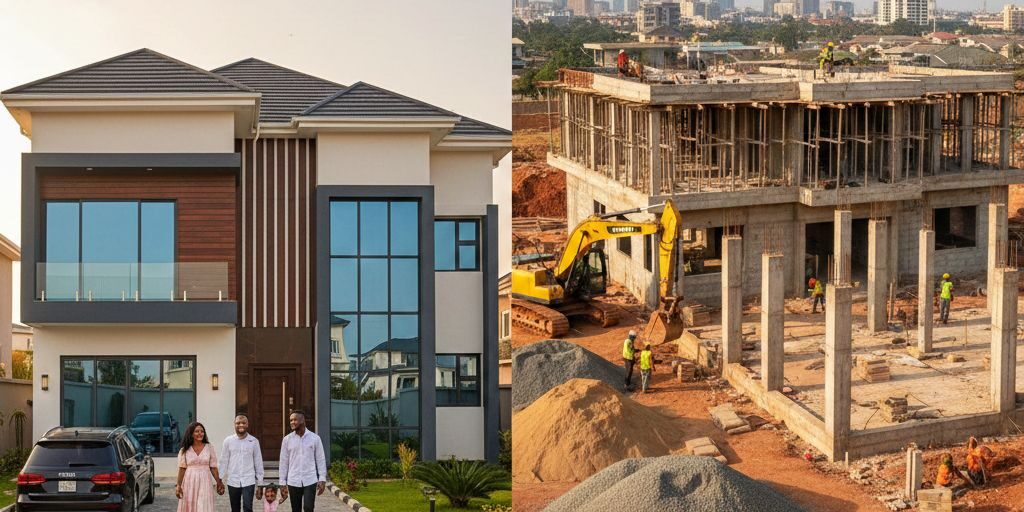
Buying vs. Building in Nigeria: What Are The Differences In Cost?
The question of buying vs building in Nigeria cost differences keeps many aspiring homeowners awake at night. Your colleague built his four-bedroom house in Ajah for what seemed like a bargain. Your sister bought a similar property in Lekki and paid significantly more. Who made the smarter financial decision?
The answer depends on factors most Nigerians overlook when calculating the true buying vs building in Nigeria cost comparison.
The Real Cost of Building Your Home in Lagos
Building a four-bedroom duplex on a 500-square-meter plot in Lagos requires more than just construction expenses. Land acquisition in areas like Lekki, Ajah, or Ikoyi starts from ₦25 million to ₦80 million, depending on location and documentation status. Many buyers forget that securing a Certificate of Occupancy adds another ₦3-5 million to their budget.
Construction costs currently sit between ₦350,000 and ₦500,000 per square meter for quality finishes in Lagos. A 300 square meter duplex, therefore, costs ₦105 million to ₦150 million in construction alone. This figure assumes you have reliable contractors who deliver on schedule. Research from the Nigerian Institution of Estate Surveyors and Valuers shows that 60% of self-build projects in Lagos exceed their initial budgets by 30-40%.
Your architect charges 5-7% of the total construction cost. Engineers take another 3-5%. Quantity surveyors add 2-3%. Before laying your first block, professional fees consume ₦8-12 million on a ₦150 million project. These expenses happen whether construction progresses smoothly or faces delays.
What You Actually Pay When Buying Ready Properties
Purchasing a completed property in prime Lagos locations like Lekki Phase 1 eliminates construction uncertainties but commands premium pricing. A four-bedroom duplex in established areas sells for ₦180-300 million depending on finishes and exact location. This price includes all documentation, infrastructure, and immediate habitability.
The buying vs building in Nigeria cost analysis shifts when you factor in financing. Most developers offer payment plans spanning 12-24 months at 0% interest. Banks charge 18-25% annual interest on construction loans, while mortgage facilities through MREIF offer 9.75% for completed properties. Your ₦150 million construction loan costs ₦27-37.5 million in interest over the construction period, assuming 24 months of completion.
Buyers of ready properties move in immediately and start building equity. Self-builders wait 18-36 months while paying rent elsewhere. If you currently pay ₦3 million annual rent, building your home costs an additional ₦4.5-10.8 million in continued rental expenses during construction.
Hidden Expenses Most People Miss
Security costs during construction average ₦80,000-150,000 monthly in Lagos. Multiply this by 24 months and add ₦1.92-3.6 million to your building budget. Material price fluctuations pose another risk. Cement prices jumped 40% between January 2024 and December 2024, according to Manufacturers Association of Nigeria data. Your initial ₦150 million budget becomes ₦170-180 million when cement, iron rods, and other materials increase mid-construction.
Buying completed properties transfers these risks to developers who absorb cost variations. Your agreed purchase price remains fixed regardless of market fluctuations. This price certainty helps families plan their finances accurately.
Infrastructure represents another hidden cost. Self-builders in emerging areas spend ₦2-5 million on boreholes, ₦1-3 million on alternative power solutions, and ₦500,000-1.5 million on drainage systems. Established estates include these amenities in purchase prices, spreading costs across multiple homeowners.
Time Investment Changes Everything
Building your home requires active project management. Site visits consume 10-15 hours weekly for 18-36 months. Professional Nigerians often hire project managers at ₦300,000-500,000 monthly, adding ₦5.4-18 million to total costs. Your time also carries monetary value. Missing work for site supervision costs opportunities and advancement.
Buying ready properties requires minimal time investment. Property inspection, documentation review, and purchase completion happen within weeks. You redirect your time toward career growth and family instead of monitoring contractors and resolving construction disputes.
Making Your Decision
The buying vs building in Nigeria cost comparison reveals that building seemingly costs less upfront but accumulates expenses through delays, price fluctuations, and opportunity costs. A ₦150 million self-build project typically reaches ₦180-200 million when accounting for professional fees, interest, continued rent, security, and hidden expenses. Ready properties priced at ₦200-250 million suddenly appear competitive when you factor in immediate occupancy, price certainty, and time savings.
Your choice depends on your risk tolerance, available time, and financial capacity to handle budget overruns. Both paths lead to homeownership, but understanding true costs prevents financial surprises.
Ready to explore premium completed properties that eliminate construction uncertainties? Contact Edenbrooks Homes today for a detailed property tour and transparent pricing. Our Lekki Phase 1 developments offer move-in-ready homes with flexible payment plans designed for busy professionals who value their time and peace of mind.