

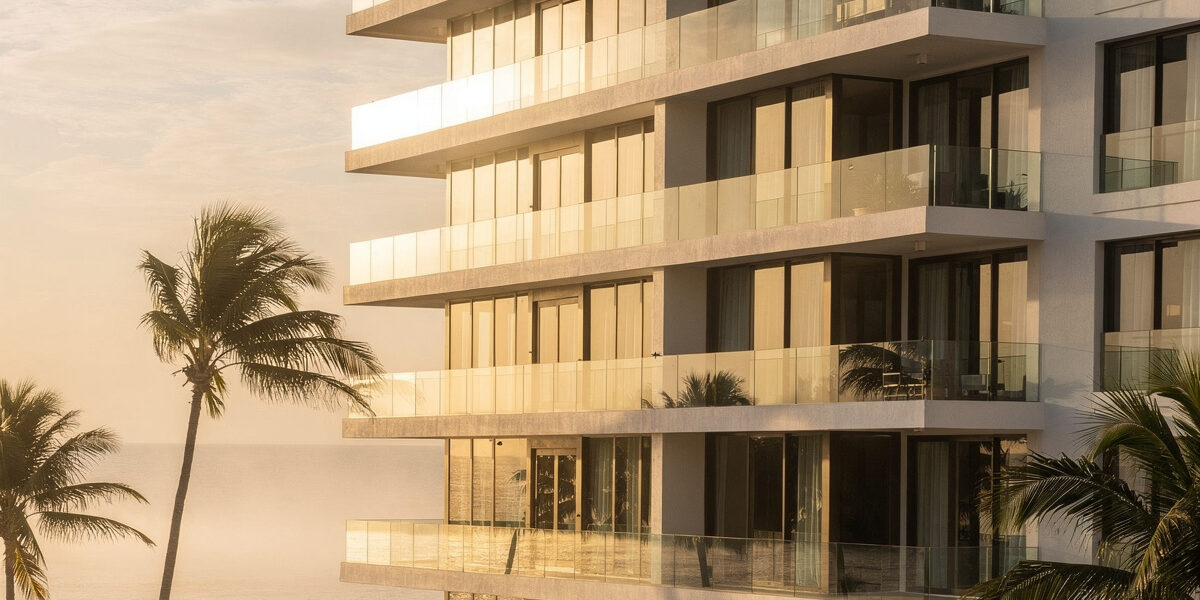
Sea Air Is Quietly Eating Buildings in Lekki, VI and Ikoyi
The damage does not announce itself. A hairline crack appears on a balcony beam. A rust stain bleeds through fresh paint near a window. A chunk of concrete falls from a soffit, and everyone assumes it was a bad batch. In coastal Lagos, it usually is not. It is the air.
Lekki, Victoria Island and Ikoyi sit on a thin, low strip of land between the Atlantic and the lagoon. The same sea breeze that makes these the most desirable postcodes in Nigeria also carries salt, and salt is quietly corroding the steel inside thousands of buildings. Sea air damage to buildings is not dramatic. It is slow, invisible for years, and expensive by the time you can see it.
This article explains the science of what is happening, why these three neighbourhoods are the most exposed in Lagos, and what actually protects a building against it.
What Sea Air Damage to Buildings Actually Is
Reinforced concrete is concrete in which steel bars are embedded. The concrete gives compression strength. The steel gives tensile strength. The building depends on both working together, and the steel depends on the concrete to protect it.
Fresh concrete is highly alkaline, and that alkalinity forms a thin passive film on the steel that stops it rusting. Salt breaks that protection. As a peer-reviewed review of how chlorides corrode rebar explains, chloride ions from sea air migrate through the concrete pores until they reach a critical concentration at the steel surface, where they disrupt the passive layer and start localised corrosion.
Then comes the real damage. Rust takes up far more space than the steel it replaces. The same review notes that corrosion products occupy roughly two to six times the volume of the original steel, and that expansion generates internal pressure that cracks, delaminates and spalls the concrete cover.
That chain reaction is the whole of sea air damage to buildings, and the sequence is brutal. Salt gets in. Steel rusts. Rust swells. Concrete cracks. Cracks let in more salt and water. The process feeds itself, and every stage is hidden inside the structure until the surface finally gives way.
Why Lekki, VI and Ikoyi Are the Worst Hit
Not every building in Lagos faces the same risk. Distance from the water is the single biggest factor, and these three neighbourhoods are almost entirely within the danger zone.
Airborne salt does not travel far. Studies of coastal corrosion show that salt deposition falls sharply inland, with the strongest effect concentrated within the first few hundred metres of the shoreline and decaying rapidly beyond it. Lekki, Victoria Island and Ikoyi are narrow coastal and lagoon-fringed strips. Large parts of all three sit inside that high-deposition band, hit from both the Atlantic and the lagoon.
The international standard on atmospheric corrosion, the ISO 9223 corrosivity standard, names airborne salinity as one of the three key drivers of metal corrosion, alongside temperature and humidity. It places coastal areas with strong salt influence in its most severe corrosivity categories. Marine air is, by the standard’s own classification, about the most aggressive ordinary environment a building can sit in.
Lagos then adds heat and moisture. The city’s high year-round humidity, averaging above 80% for much of the year, keeps surfaces damp for longer. Research on corrosion in tropical coastal air shows that high temperature and humidity shorten the time before corrosion begins. Warm, wet, salty air is the perfect accelerant, and that is the Lagos coastline for most of the year.
This Is Documented in Lagos, Not Just in Textbooks
It would be easy to treat this as a foreign engineering concern. It is not. It has been measured here.
A 2026 durability study of a reinforced concrete structure in the Lagos Lagoon, published in a Nigerian engineering journal, put hard numbers to it. The Lagos Lagoon durability study recorded a water chloride concentration averaging around 3,050 mg/L and named it the primary driver of corrosion. Inspection found severe corrosion on the structure’s beams and underside, and the concrete tested below the strength recommended for such an aggressive environment.
The study’s conclusion matters for every coastal building, not just marine structures. Where concrete quality is inadequate for the exposure, deterioration accelerates, and routine maintenance becomes essential rather than optional.
A broader marine concrete durability review from 2025 reaches the same conclusion: chloride-driven reinforcement corrosion significantly shortens the service life of concrete structures and raises repair and retrofitting costs over their lifetime. In plain terms, a building on the water that was not built for the water ages faster and costs more to keep standing.
The 5 Things That Decide Whether a Coastal Building Survives
The difference between a building that shrugs off sea air and one that crumbles under it is decided almost entirely during construction. These are the factors that matter, and they are the questions a serious coastal buyer should be asking.
1. Dense, low-water concrete
The most important defence is the concrete itself. Marine design standards call for a low water-to-cement ratio, typically at or below 0.40, to produce a dense mix that salt struggles to penetrate. Chloride resistance is about how impermeable the concrete is, not just how strong it feels. A cheap, watery mix fails on the coast no matter how it looks on day one.
2. Adequate concrete cover over the steel
The steel needs a thick enough layer of concrete over it to keep chlorides away for as long as possible. Coastal and splash-zone structures require deeper cover than inland ones. Thin cover, often the result of a developer saving on materials, is one of the fastest routes to early corrosion.
3. Corrosion protection on the reinforcement
Beyond the concrete, the steel itself can be protected. Options include corrosion-inhibiting admixtures in the mix, and, for the most exposed elements, galvanised, epoxy-coated or stainless reinforcement. These cost more upfront and are precisely the kind of specification a budget builder quietly deletes.
4. Protective coatings and marine-grade fittings
External renders and protective coatings slow moisture and salt reaching the concrete. External fittings, railings, window frames and fixings should be aluminium, uPVC or stainless rather than ordinary steel, which streaks and fails within a few salty years.
5. Actual, scheduled maintenance
No coastal building is maintenance-free. Sealing hairline cracks early, repainting on schedule and inspecting for rust staining before it becomes spalling is the difference between minor upkeep and major structural repair. The Lagos Lagoon study said it directly: routine maintenance is not optional on the water.
What This Means If You Are Buying on the Coast
For a buyer, this is not a reason to avoid Lekki, Victoria Island or Ikoyi. These remain the strongest addresses in Lagos. But sea air damage to buildings is a reason to care intensely about who built the property and how.
The corrosion timeline works against you as a buyer because the damage is invisible for years. A building can look flawless at viewing and be quietly rusting inside its beams. By the time stains and cracks appear, the repair is structural and costly. This is exactly the kind of hidden shortcut we cover in our guide on how developers cut corners in Lagos, where thin concrete cover and weak mixes are among the most common and most damaging.
So the due diligence on the coast is not only about title and price. It is about specification. Ask what the concrete mix was. Ask about cover depth and corrosion protection. Ask what the external fittings are made of. A developer who built for the environment can answer. A developer who cut corners will change the subject.
The True Cost of Getting It Wrong
The reason sea air damage to buildings is so dangerous financially is that it is cheap to prevent and ruinous to fix. Specifying the right concrete mix and cover depth at construction adds a modest amount to the build. Repairing corroded structural beams a decade later means breaking out concrete, treating or replacing steel, and recasting, often while people are living in the building.
There is a resale dimension too. A coastal property with visible rust staining, spalling balconies or a history of structural repair is far harder to sell at a premium, and any serious buyer’s surveyor will flag it. In a market where prime Lekki, Victoria Island and Ikoyi values depend on a property presenting as sound, hidden corrosion is a direct threat to the one thing that makes these addresses worth their price.
This is why the quality of the developer matters more on the coast than almost anywhere else. Sea air damage to buildings is decided by choices buried inside the structure, choices you cannot see at a viewing and cannot easily verify after purchase. You are, in effect, trusting whoever poured the concrete.
How Edenbrooks Homes Builds for the Coast
At Edenbrooks Homes, we build in Lekki Phase 1, which means we build for the sea air every day. The specification that protects a coastal building is not an upgrade we offer. It is the standard we start from because we intend our developments to remain sound decades after the sale.
Our developments, including Maison D’Eko Residences III, Maison D’Eko Residences, and Wakefield Apartments, are built to hold their value and their structure in a demanding coastal environment, not just to photograph well at handover.
Contact us today to start the conversation. Our team will walk you through exactly how each Edenbrooks property is built to resist the salt air of Lekki, Victoria Island and Ikoyi, before you commit a naira.
Email: [email protected] | Call/WhatsApp: +2347060474224 | +2348087691124